
Technical Insight · Fastener Die Engineering
From Wire to Part: Inside the Dies That Form Automotive & Specialty Fasteners
A closer look at the tungsten carbide knurling dies and 5-station progressive die sets behind high-volume, high-precision fastener production — and what U.S. manufacturers should know before specifying their next tool.
A finished automotive fastener — a flange nut, a knurled shoulder bolt, a specialty hex part — looks simple in a parts bin. What's easy to miss is that every dimension on that part was decided long before the fastener existed, by the tooling that formed it out of raw wire. "From wire to part" isn't a tagline; it's the actual manufacturing sequence, and every stage of that sequence lives or dies on die design.
Two die types illustrate this especially well: tungsten carbide knurling dies and multi-station progressive die sets. Both are workhorses on automotive fastener lines, and both fail — or succeed — for very specific, very technical reasons.
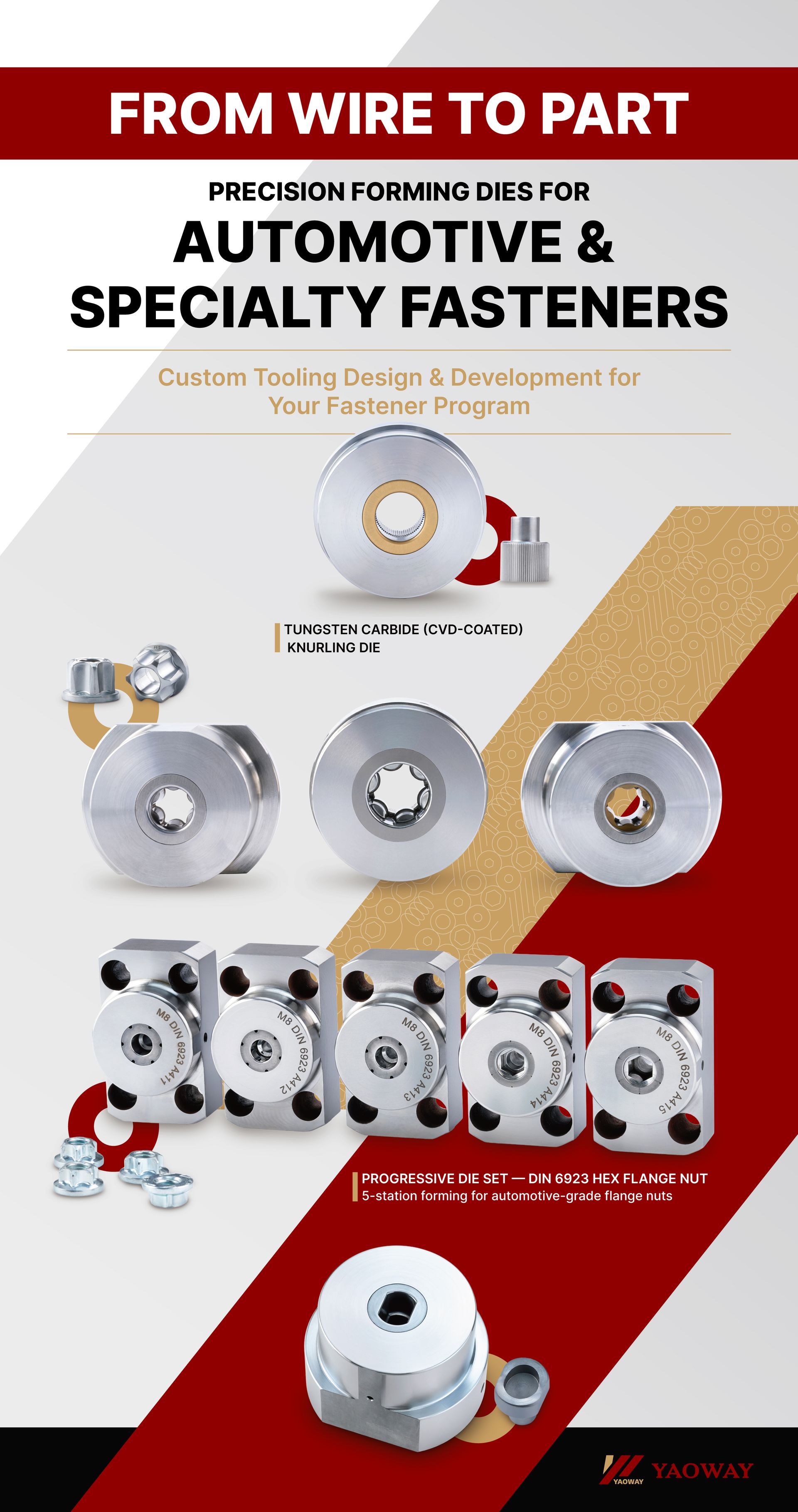
Tungsten Carbide (CVD-Coated) Knurling Dies
Knurling dies impart a repeating pattern — straight, diamond, or helical — onto a fastener's shoulder or head, typically to create a press-fit surface or improve grip. The forming action is almost entirely surface contact and friction, which makes wear resistance the dominant design variable.
Tungsten carbide is the material of choice here for a simple reason: its hardness (typically 1,400–1,800 HV, versus roughly 600–800 HV for hardened D2 tool steel) lets it hold a fine, sharp knurl pattern through far more cycles before the pattern edges round off. On top of the base carbide, a CVD (chemical vapor deposition) coating adds a hard, low-friction outer layer — often titanium carbide or a multi-layer carbide/nitride stack — that further reduces galling and material pickup, which is what actually causes knurl patterns to degrade over time.
The trade-off is cost and machinability: carbide is harder to grind and EDM than tool steel, and a CVD-coated carbide die costs meaningfully more upfront. For high-volume automotive programs, that upfront cost is almost always recovered through extended die life and fewer mid-run changeovers — but it only pays off if the coating and substrate are actually matched to the fastener material and production speed, not applied as a blanket upgrade.
5-Station Progressive Die Sets: The DIN 6923 Example
A DIN 6923 hex flange nut looks like a single-operation part, but it isn't formed in one hit. On a progressive former, wire is fed through a sequence of dies — typically five stations — each performing one controlled deformation step: upsetting the blank to volume, forming the flange, shaping the hex body, piercing and extruding the through-hole, and finishing/sizing the thread seat.
The engineering challenge isn't any single station — it's the sequence. Each station has to leave the blank in the correct volume, concentricity, and work-hardening state for the next one. Get the material flow wrong at station 2, and station 5 inherits a part that's out of tolerance no matter how well that last die is made. This is why progressive die sets are designed and cut as a matched system, station-to-station, rather than as five independent tools that happen to share a part number.
For automotive-grade flange nuts specifically, this matters because the flange bearing surface and hex drive both carry functional tolerances — flange flatness affects clamp load consistency, and hex geometry affects tool engagement and installation torque repeatability on an assembly line. A progressive die set that isn't held to tight station-to-station tolerance will produce parts that pass a spot check and still cause installation variance downstream.
What This Means When You're Specifying a Die
- Match substrate and coating to the job. Carbide with CVD coating earns its cost on high-volume, high-friction operations like knurling — it's not automatically the right call for every station.
- Ask how the progressive sequence was validated. A die set engineered station-by-station against actual material flow simulation behaves very differently on the floor than one designed part-first and reverse-engineered into stations.
- Confirm dimensional control at the functional surfaces — flange flatness, hex geometry, thread seat — not just at the easiest-to-measure features.
Meet Us at the 2026 International Fastener Expo
YAOWAY Associates Co., Ltd. — Booth 4137
October 8–9, 2026 · Phoenix Convention Center
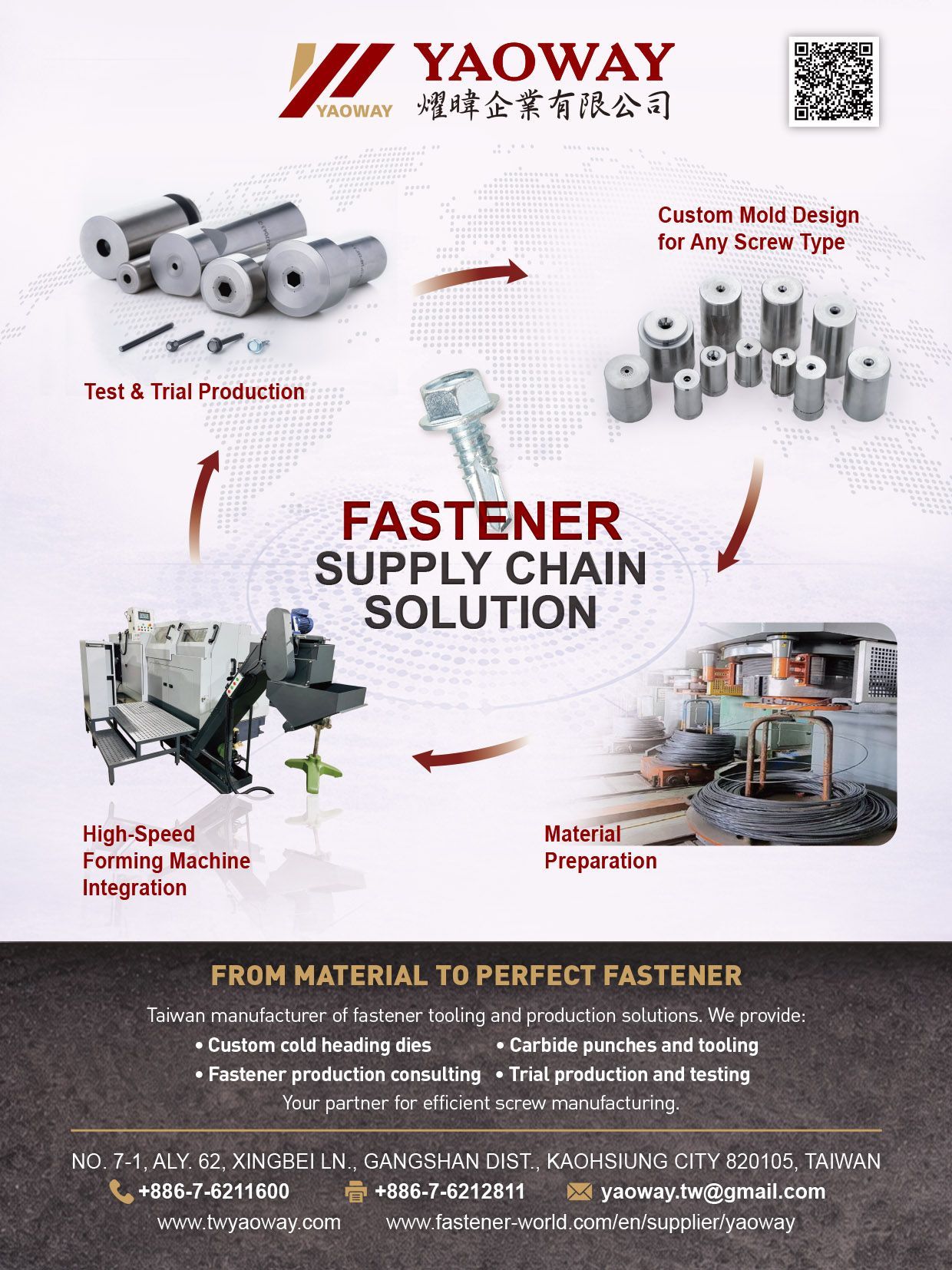
From tungsten carbide knurling dies to full progressive die sets for automotive-grade fasteners, YAOWAY designs tooling around your actual material flow and production speed — not a generic catalog spec. Stop by Booth 4137 to walk through your part with our engineering team.
Schedule a Meeting at Booth 4137 →The Bottom Line
"From wire to part" is a useful shorthand, but the real story is in the tooling decisions along the way — carbide versus tool steel, coated versus uncoated, five independently-made dies versus one engineered progressive sequence. For automotive fastener programs where clamp load, torque repeatability, and scrap rate are all on the line, those decisions are exactly what's worth discussing with your die supplier before the first blank ever runs.
Questions about die specs for your fastener line? Reach the YAOWAY team at yaoway.tw@gmail.com or visit twyaoway.com/resource.